
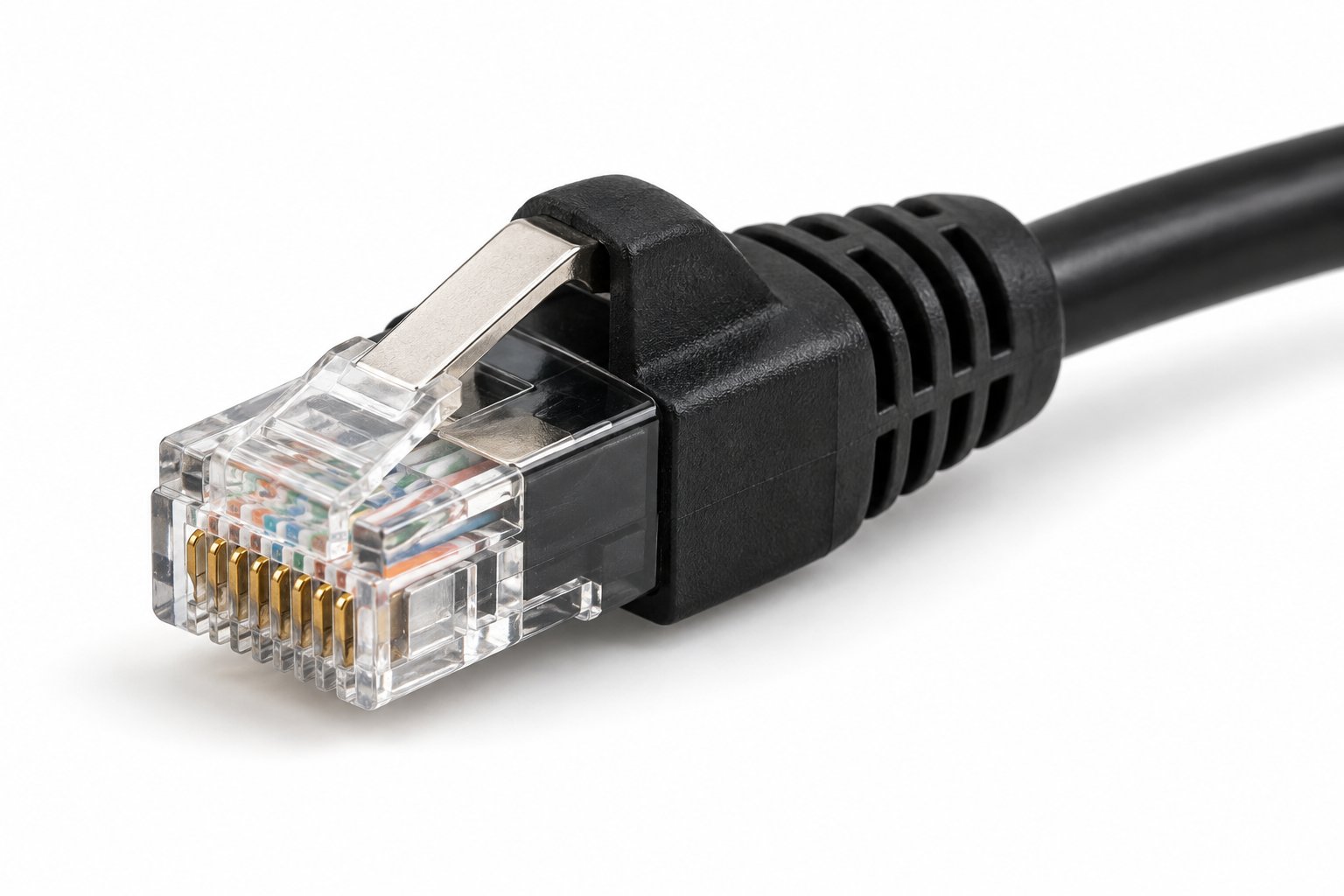
An RJ45 port is the most common Ethernet interface on industrial equipment, and it is also one of the easiest to knock loose. On a machine that vibrates, on a camera bracket that moves with a pan-tilt head, or on a cabinet door that gets opened for service, a standard RJ45 plug relies on a small plastic latch that can snag, crack or simply release. Add water, dust or wash-down spray and the same port becomes a failure point that takes a whole network segment offline.
The products discussed in this guide are listed under industrial RJ45 connectors. The two families covered here are the molded industrial RJ45 connector with latch-based retention and locking head options, and the waterproof RJ45 plug-and-socket set for exposed or wet locations. The aim is practical: help you choose the right retention and sealing approach for your enclosure and cable, and give you the words to put in an inquiry so the supplier quotes the right variant the first time.
Key takeaways
- "Push pull RJ45" on an industrial footprint does not automatically mean a push-pull sleeve mechanism. In the TRCONN range, retention is by the RJ45 latch clip, with vertical or horizontal locking head variants.
- Three molded head styles — straight, elbow and flat — each available with vertical or horizontal locking, cover most panel layouts.
- Molded connectors suit volume fixed harnesses; the field-terminable assembled version suits cable cut to length on site.
- For rain, splashes or wash-down, a sealed plug-and-socket pair is the appropriate product, not a single connector.
- Your inquiry should state head style, locking direction, molded or assembled, cable type, mounting arrangement, environment and quantity.
What this guide covers
- What buyers usually mean by "push pull RJ45"
- Retention options that actually exist on industrial RJ45 hardware
- Molded vs field-terminable connectors
- Sealed plug-and-socket pairs for outdoor and wash-down ports
- Choosing by environment, panel layout and build process
- What to put in an inquiry
- FAQ
What buyers usually mean by "push pull RJ45"
The term push pull rj45 is used loosely in industrial Ethernet sourcing. It can mean three different things, and they lead to different products:
- A positive-lock Ethernet connector. The buyer wants an RJ45 that will not release under vibration or cable pull. The requirement is retention, not necessarily a particular mechanism.
- A push-pull sleeve coupling. In circular connector families, push-pull describes a sleeve that locks on insertion and releases when the sleeve is pulled. Buyers sometimes carry that vocabulary over to RJ45 footprints where the mechanism is different.
- A protected, sealed port. The real problem is dust and moisture ingress rather than retention, and the answer is a sealed plug-and-socket pair.
For the TRCONN industrial RJ45 range, the accurate description is: RJ45 latch-clip retention, reinforced by molded head designs and available in vertical and horizontal locking versions, plus a separate waterproof plug-and-socket set for ports that need sealing. These products do not use a push-pull sleeve mechanism. If your specification calls for a sleeve-locking interface, that is a different connector family and should be discussed with the supplier up front.
Why does this distinction matter? Because a purchase order that says "push pull RJ45" without further detail can be quoted against several different constructions. The connector that arrives might retain well but not seal, or seal well but not fit an elbow-layout panel. Naming the function you need — retention, sealing, both — is the first step to a correct quote.
Retention options that actually exist on industrial RJ45 hardware
Industrial RJ45 retention falls into a small number of practical approaches. The table below compares them as they apply to the product families in this guide.
| Retention approach | How it works | Typical use | Limitations to check |
|---|---|---|---|
| Standard RJ45 latch clip | The plug's molded latch clips into the jack. Common on office-grade patch leads. | Protected cabinet interiors, short patch runs, static equipment. | Latch can snag on adjacent cables or break if the plug is pulled by the cord rather than the body. |
| Molded head with latch protection | The RJ45 interface is overmolded into a head that shields the latch area and provides a larger gripping body. | Machine-mounted cameras, controllers, switches, networked production equipment. | Still a latch-based retention; the head protects the latch rather than replacing it. |
| Molded head with vertical or horizontal locking version | Every head style is offered in a vertical or horizontal locking variant, adding a positive lock at the panel or mating point. | Vibrating machinery, moving brackets, panels where the cable may be pulled. | Choose the locking direction to match the panel layout; a mismatched direction complicates cable routing. |
| Sealed plug-and-socket pair | A waterproof RJ45 plug on the cable side mates with a matching waterproof socket on the equipment side; sealing is built into the connector interface. | Outdoor cameras, equipment exposed to rain, splashes or wash-down. | Ordered as a pair; the socket must be specified in vertical or elbow arrangement to match the enclosure. |
Two points are worth stating plainly. First, the locking variants in the molded RJ45 family are a retention feature built into a latch-based connector, not a push-pull sleeve. Second, the waterproof family solves ingress by pairing a sealed plug with a sealed socket — it is a system, not a single part. Buyers who ask for "a push pull RJ45 connector" are usually satisfied by one of these two families once the requirement behind the term is clarified.
Molded vs field-terminable connectors
The RJ45 industrial molded connector family is supplied in two build formats. The difference is where the cable termination happens.
Molded version for volume fixed harnesses
In the molded version, the connector head is factory-overmolded onto the cable. This is the normal choice when:
- You are ordering harnesses in volume and the cable length is fixed by the machine design.
- You want a consistent, repeatable assembly that does not depend on field termination quality.
- The cable is built into a subassembly that will not be re-terminated later.
For a machine builder or a panel shop producing the same harness repeatedly, the molded version removes a field-termination step and the variability that comes with it.
Field-terminable assembled version for cable cut to length on site
The assembled version lets cable be cut to length and terminated on site. This is the practical choice when:
- Cable runs are measured during installation rather than predetermined.
- The installation team needs to replace or re-terminate a damaged run without ordering a new molded assembly.
- Spare cable is stocked on a reel and connectors are fitted as needed.
Neither format is better in general. The decision is about where you want the termination to happen and how much variability you can absorb in the field. A practical split is common: molded for the harnesses that ship with the machine, field-terminable for spares and site modifications.
Head style: straight, elbow and flat
Both build formats are available in three molded head styles — straight, elbow and flat. The right one is decided by the space around the port and the direction the cable must leave it:
- Straight heads suit panels with clearance directly in front of the port.
- Elbow heads turn the cable through 90° and suit enclosures where depth is limited or where the cable must run parallel to the panel.
- Flat heads suit tight spaces and low-profile routing, for example behind a device mounted close to a wall or inside a shallow cabinet.
Head style and locking direction are chosen together. A panel with limited depth may need an elbow head, and the locking version should then match the direction the cable leaves the head.
Sealed plug-and-socket pairs for outdoor and wash-down ports
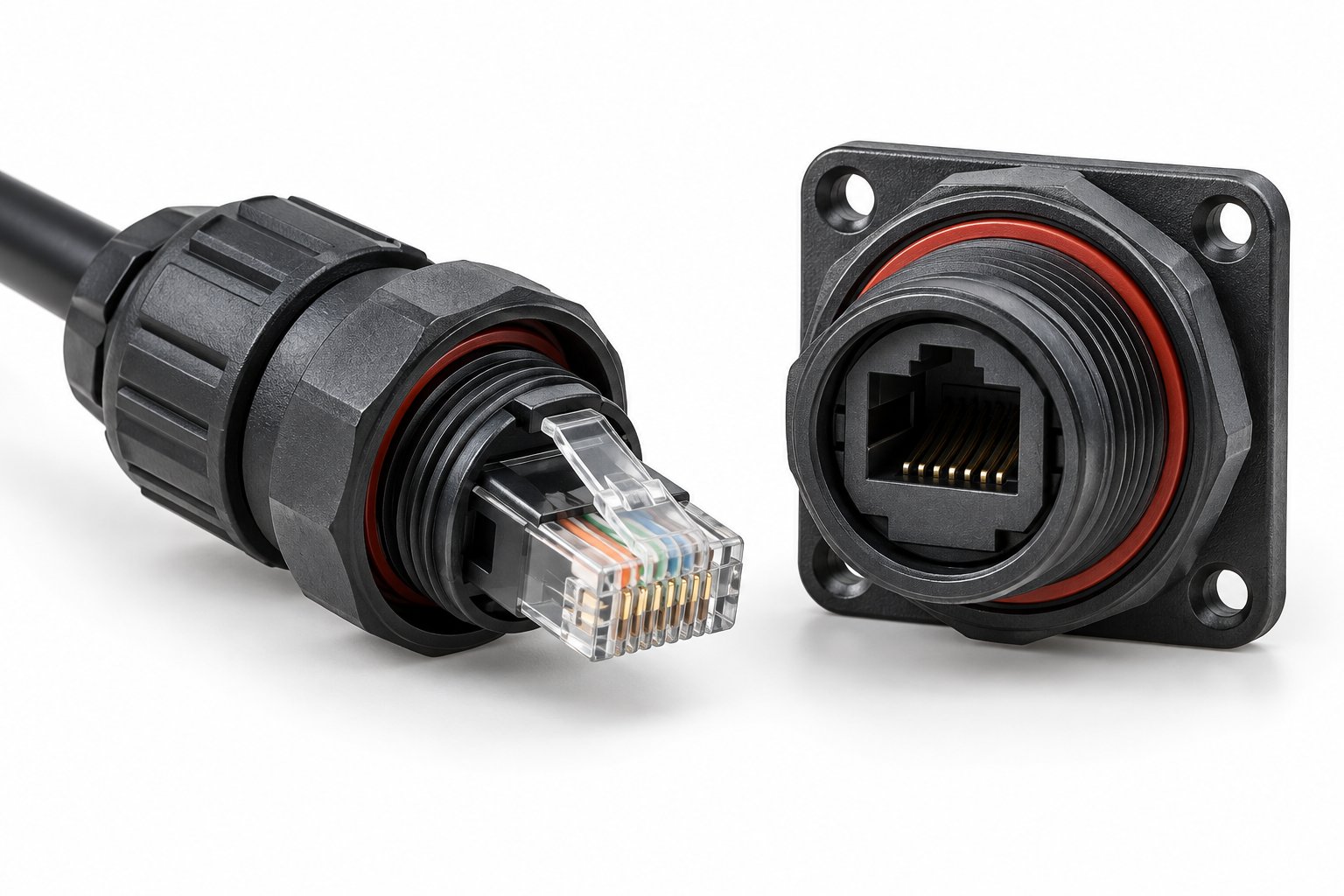
When the port is exposed to rain, splashes or wash-down, retention is only half the problem. The RJ45 interface itself must be isolated from the environment. The RJ45 waterproof industrial connector addresses this by being ordered as a set: a waterproof RJ45 plug for the cable side and a matching waterproof socket for the equipment side.
Key characteristics of this family:
- Ordered as a set. The plug and socket are designed together; sealing is built into the connector interface.
- Socket in vertical and elbow arrangements. The vertical socket points straight out of the enclosure; the elbow socket turns the cable through 90°, which helps where depth is limited or where the cable should run along the equipment surface.
- Standard RJ45 pinout. The connector keeps the ordinary RJ45 pinout, so it works with standard RJ45 network hardware such as switches, cameras and controllers. You are changing the mechanical protection of the port, not the network protocol.
Typical applications for this family include outdoor cameras, networked machines and equipment exposed to rain, splashes or wash-down. The practical question is whether the port is wet or merely dirty. For a dry but vibrating panel inside a cabinet, the molded family with locking variants is usually the simpler answer. For a port that will see water, specify the sealed pair.
Choosing by environment, panel layout and build process
Three questions usually settle the choice: where the port is, what is around it, and how the cable is built.
Step 1 — Environment
| Environment | What matters | Recommended family |
|---|---|---|
| Indoor machine, cabinet interior, dry but vibrating | Retention against vibration and accidental pull | Molded RJ45 connector with vertical or horizontal locking version |
| Indoor panel, cable must leave at 90° | Panel depth and cable routing | Molded connector, elbow head, locking direction matched to routing |
| Outdoor camera or enclosure exposed to rain | Water ingress at the port | Waterproof RJ45 plug-and-socket pair, socket in vertical or elbow arrangement |
| Wash-down area | Repeated splash and cleaning | Waterproof pair; confirm with the supplier that the variant suits the cleaning regime |
Step 2 — Panel layout
Look at the port from three directions before choosing a head:
- Depth in front of the port. If there is no room for a straight cable bend, choose elbow or flat.
- Locking direction. The locking version is offered in vertical or horizontal; pick the one that can be released by hand with the panel installed.
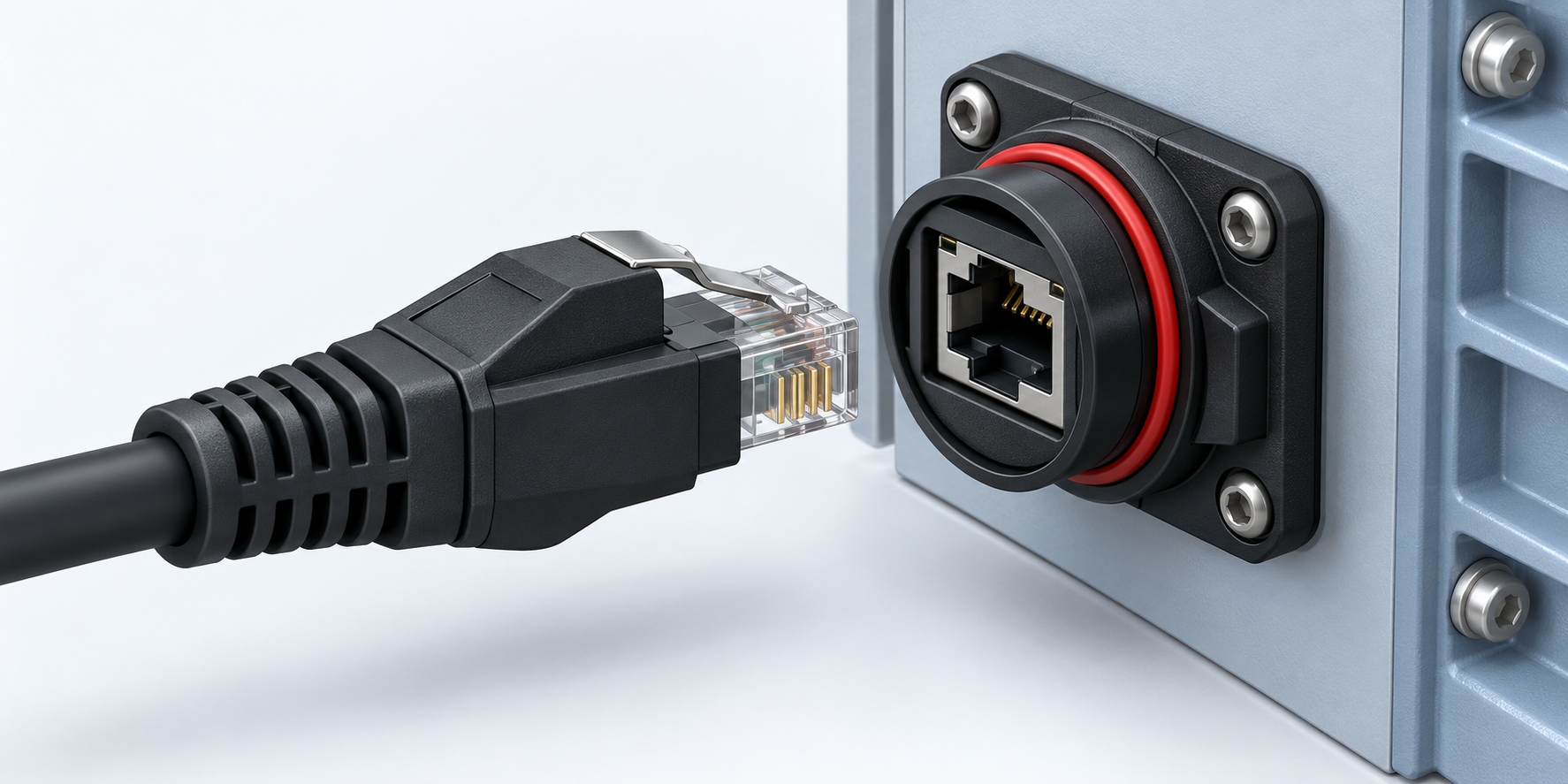
- Socket orientation for sealed ports. The waterproof socket is available in vertical and elbow arrangements. An elbow socket is often the practical choice on a machine side panel where a cable hanging straight out would be exposed.
Step 3 — Build process
Decide where the termination happens. If harnesses are built in volume with fixed lengths, the molded version gives a repeatable assembly. If installation teams cut cable to length, keep the assembled field-terminable version available for those runs and for spares. Mixing the two is normal: molded for original build, field-terminable for service.
What to put in an inquiry
Most delays in industrial connector sourcing come from an incomplete first message. The supplier has to guess the head style or the locking direction, and the quote comes back with the wrong variant. A short, structured inquiry avoids that.
For the molded industrial RJ45 connector
- Head style: straight, elbow or flat.
- Locking direction: vertical or horizontal.
- Build format: molded or field-terminable assembled.
- Cable type: the cable construction you plan to use or have specified.
- Quantity: per variant, not just a total.
For the waterproof RJ45 connector
- Mounting arrangement: vertical or elbow socket.
- Cable entry: how the cable enters the plug and from which direction.
- Environment: rain, splash or wash-down, so the supplier can confirm the variant.
- Quantity: number of plug-and-socket sets.
Two further items help if they are known: the equipment type the port is on, and whether the connector must mate with an existing socket already installed on the equipment. The second point matters because the waterproof family is ordered as a matched pair — if a socket is already fixed on the machine, the plug must match it.
FAQ
Does a "push pull RJ45 connector" use a push-pull sleeve?
Not necessarily. In the TRCONN industrial RJ45 range, retention is by the RJ45 latch clip, with molded heads and vertical or horizontal locking variants. The waterproof family seals the port with a plug-and-socket pair. If your design requires a sleeve-locking mechanism, state that explicitly in the inquiry so the supplier can confirm whether it is available.
Can I use the waterproof RJ45 connector with ordinary network switches and cameras?
Yes. The waterproof connector keeps the standard RJ45 pinout, so it works with standard RJ45 network hardware. What changes is the mechanical protection of the port, not the electrical interface.
Do I need to order the waterproof plug and socket together?
The waterproof RJ45 connector is ordered as a set: a plug for the cable side and a matching socket for the equipment side. This ensures the two halves are designed to seal together.
Which head style should I choose for a panel with limited depth?
Elbow or flat heads are the usual choices where there is no room for a straight cable bend. The locking direction should then be selected to match the direction the cable leaves the head, and to remain accessible for release with the panel installed.
What IP rating do these connectors have?
The product records for these items do not state an IP rating, mating-cycle count, temperature range or material specification. If these parameters are part of your qualification, ask the supplier to confirm them for the exact variant before ordering.
Need help specifying the right variant?
Send TRCONN the head style, locking direction, molded or assembled format, cable type and quantity for the industrial RJ45 connector, or the mounting arrangement, cable entry and environment for the waterproof set. We will confirm the matching variant and quote accordingly.
Contact TRCONN