
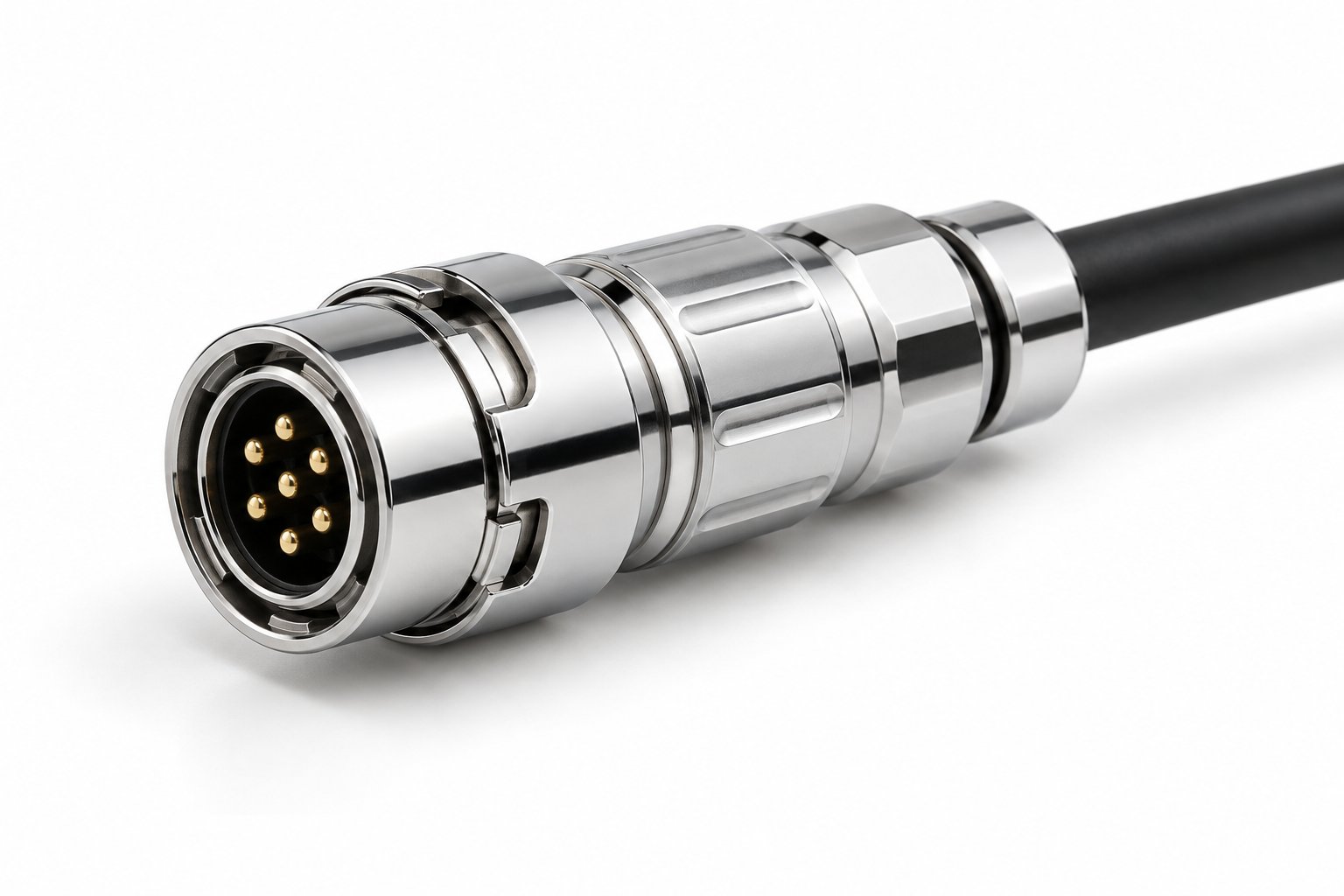
A push-pull self-locking connector is a purely mechanical latch: push the plug onto the socket and it locks; pull the release sleeve and it unlocks. No tools, no threaded collar, one hand. That is the whole idea — but the way it achieves it explains why these connectors are used on medical devices, test instruments and industrial control panels where a loose cable would stop the whole machine.
Stage 1: Push to lock
The operator aligns the plug with the socket entry along the axis and pushes. Inside, a latch sleeve rides over the locking groove and snaps into place. The connection completes with an audible click and a clear tactile detent, so the person mating it knows the lock has engaged without looking at the back of the panel.
Stage 2: Locked against pull-out
Once mated, the connector stays in the locked state. Until someone deliberately operates the release sleeve, pulling on the cable or tugging the connector body does not release the latch. The cable can be brushed, snagged or vibrated without the pair separating — which is the property that matters most on moving equipment and in crowded cabinets.
Stage 3: Pull the sleeve to release
To disconnect, the operator hooks the release sleeve on the socket's outer ring and pulls back along the axis. The internal locking pins retract and the plug exits smoothly. Unmating takes one hand and about the same effort as mating it.
Where this mechanism earns its place
- High-density panels: no wrench clearance is needed around each connector, so units can sit closer together than threaded connectors allow.
- Frequent mating: series in this product family are rated beyond 2,000 to over 5,000 mating cycles depending on the series.
- Mismatch prevention: positioning-pin keying with several key angles means two identical-size connectors on the same panel can be keyed differently, so a wrong-line connection physically cannot be made.
- Vibration-prone mounts: the latch holds without a back-off nut, so there is nothing to loosen over time.
What the ratings mean in practice
On TRCONN push-pull connectors, the B Series for example covers 2–32 contacts in six shell sizes (00B to 4B) with IP50 protection when mated, over 5,000 mating cycles, a -55 °C to +250 °C temperature range and shielding of at least 75 dB at 10 MHz. Waterproof variants — the K, T and W Series — reach IP66 to IP68 with O-ring and thread sealing. The right series follows the environment: IP50 for clean indoor panels, sealed series for outdoor or wash-down equipment.
If you are comparing locking mechanisms for a new design, the practical check is threefold: cycle rating against your service frequency, protection level against the installation environment, and the keying scheme against the number of same-size connectors on your panel.
Tell us your contact count, panel space and environment, and we will point you to the matching series and shell size.
Contact TRCONN